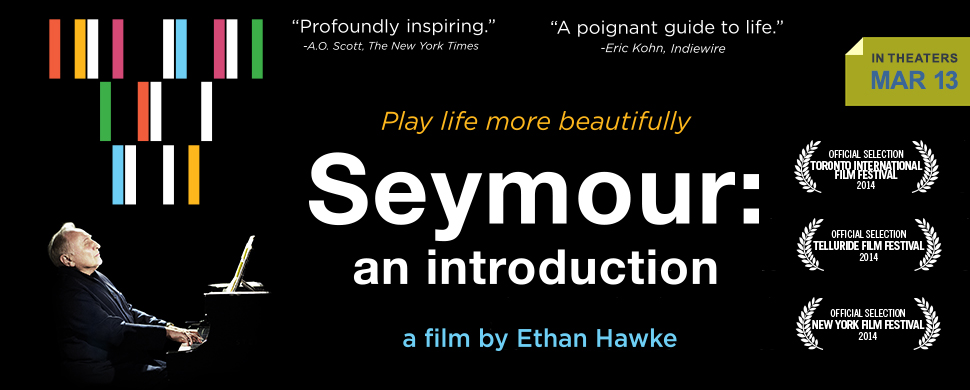
A great podcast series (featured here previously) comes from the Film Society of Lincoln Center’s archive of post-screening discussions. Usually right at the edge of celeb fawning, though just shy of becoming an all-out Actor’s Studio Liptonfest, this episode pays tribute to the work of actor/director Ethan Hawke. On the heels of his Linklater years, evolving further into a filmmaker as Seymour: an introduction goes now into wider release, Hawke engages with interesting insights about the little genre of classical music documentaries (that I’m lately spending all my time on). Seymour Bernstein shows up at the end and plays a Brahms Intermezzo.
Leading up to (and inspiring) the launch of this site in February 2015, there were a few viral videos that folks found useful across the Interwebs. Since these videos have never gotten their own back-to-the-future debuts at this permanent residence, let’s use Throwback Thursday (TBT) as an occasion to see what they had to say.
This one was a short little test run of a product that eventually never made it to market. Soon to be covered in a forthcoming review (and already featured here in a sample video), the Nebula 4000 Lite arrived with that critical additional third axis of stabilization, and all else was left behind at this form factor. It remains interesting to compare the performance, and see how design decisions have evolved (and should have).
From August 11, 2014:
Big Balance are heading to market with their Gibbon, a 2-axis gimbal stabilizer for small cameras, and I figured that this neighborhood dog park would be a fun place to test it out. We’re all looking for that killer app, combining discreet size (much smaller than a Movi), with effortless smooth action. We’re still waiting, because that 3rd axis is crucial: up-down + tilt stabilization (2-axis) isn’t enough to get good shots, so really, adding left-to-right (3-axis) is the final frontier. Smartphone and GoPro 3-axis gimbals this small have hit the market, but nothing yet for camera weights in this ballpark: at 440 grams, I used a Blackmagic Pocket Cinema Camera for this video with a Panasonic 14mm f/2.5 lens stopped down for wide depth of field.
Any device that keeps the camera level to the horizon and looking straight ahead is useful, though. For this Big Balance Gibbon, I applied Adobe Warp Stabilizer in Premiere Pro afterward to account for that lack of a 3rd axis, setting its smoothness to a nominal 1%. It requires extra processing time, but for now, it’ll do.
“The Creek” music is by Topher Mohr and Alex Elena, from the royalty-free YouTube Sound Library.
For one reason or another (that’s gotta include false consciousness, always evading copyright law through fair use claims that never really get tested), so-called “video essays” have become as ubiquitous as Kickstarter campaigns, just the past few months especially. It might calm down, but cream always floats to the top, and we find occasional gems worth highlighting. This fine work, by Jacob T. Swinney, is less didactic, and more a study in narrative structure than visual composition as you would think. There are numerous fruits from an exercise like this, and I can’t resist rattling off a few:
- By seeing opening frames lined up with closing frames, the rubber hits the road in terms of narrative structure. How you start and end a film has the effect of compressing down gigantic gestures of style and information that fill the running time in-between. Within those few frames, if the bookends communicate irony, everything changes. If the bookends communicate fulfilled foreshadowing, we’ve gone cosmic. If the bookends have nothing to do with each other, because they don’t care, we’ve gone punk rock. And so on. What about the other 95% of the film? Incredibly, it falls away.
- What if the color saturation/grading/look is very different, between the beginning and end? That tells you something about the narrative function of color, which intimately communicates mood and dramatic tenor.
- You may notice: usually the beginning and end match in terms of focal length. No wide shots met with close-ups. What’s up with that?
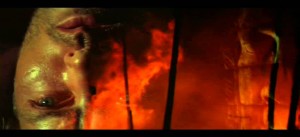
Although Swinney blanches the sound environment with a pad of twinkling musical underscore (ahem), to the arguable benefit of consistent meditation across all the visual samples, a film could start loudly and end quietly, or vice-versa. Either of those structural decisions casts a huge shadow on the rest of the film. Absent from these samples, to my mind, Apocalypse Now epitomizes it: at the beginning, remember those helicopters flying past in silence, with massive firebombs going off that you can’t even hear? Is the silence at the end of Coppola’s masterpiece any different, at the heart of darkness?- If there’s a common thread between these samples, it’s that directors like to begin and end with the same thing. At risk of hedging into cheap spiritualism, we could agree that cinema is ultimately a medium for accessing philosophical insights about the cyclical nature of things. We begin and end the same, even if storytelling fills us up with narrative details.