
I’ve got a new scooter shop in my neighborhood, and figured it could be a visually fun place to start experimenting with my new CAME-Single 3-axis gimbal stabilizer that just arrived. A more thorough review of the product is forthcoming, but in the meantime, here are some notes on this shoot.
 Apart from the standard practice of closing up apertures for wide depth of field where you just can’t manage pulling focus while flying on a gimbal, I’ve always wanted to try out steadicam style in shallow focus, using a bright prime lens. But that presents a few problems: it only makes sense to shoot ultra-wide on a gimbal, and those lenses aren’t typically bright, especially with a high crop factor like you get with the Panasonic GH4. Anything capable of shallow focus at wide focal lengths has got to be huge, and the king of them all is Voigtländer’s new 10.5mm f/0.95 lens, weighing in at 568 grams. Hooked onto the GH4 and then stacking a requisite ND filter, it’s well past the CAME-Single’s 1 kilogram weight limit. So, these results probably look worse than the normal stabilizer capability of the CAME-Single (to be confirmed soon), and I have to admit, I applied Adobe Warp onto a clip or two where things got really bad. But I was surprised that the CAME-Single didn’t freak out, and it generally did the job.
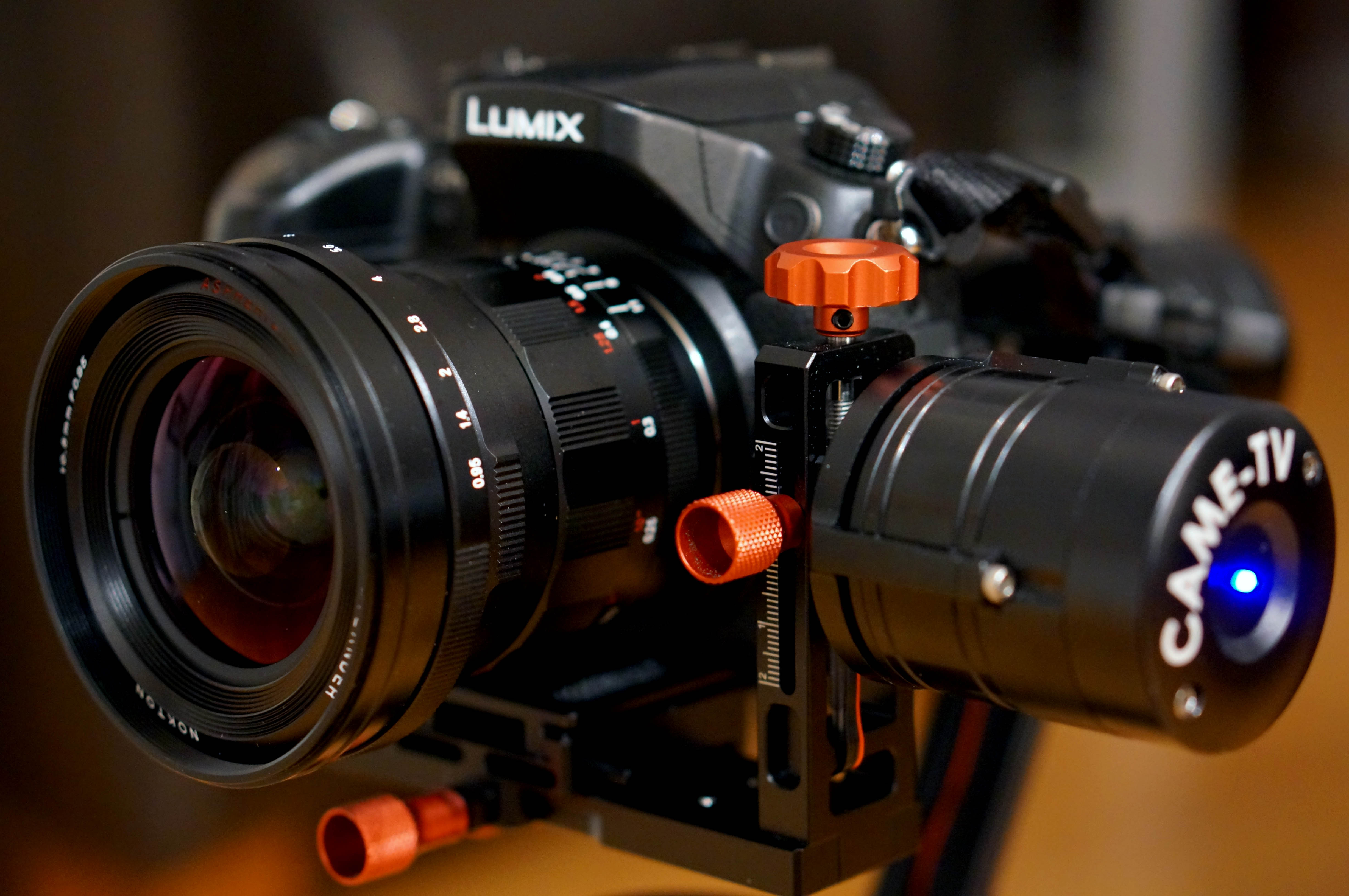
You must agree, it’s a cool look! Having that buttery bokeh while smoothly flying around like this is a really unique aesthetic. It only works when you’re keeping an equal distance to everything, as seen here starting a half-minute in. But if I wanted (or only could manage) long depth of field, I would be better off using my Olympus 9-18mm f/4 lens that’s truly miniature and wouldn’t stress the motors (but performs great). I’ll test the CAME-Single with that lens going forward, in a stabilizer round-up that includes the CAME 7800, Nebula 4000 Lite, Cinevate Morpheus, Big Balance Gibbon, and Steadicam Merlin.
Thanks to Jamie at La Moto Washington for letting me roam around. He’s running the best shop in the mid-Atlantic region for scooters and motorcycles.
Note that you can play the video back in 4K-UHD, on a capable monitor, by enlarging it to full-screen. If that doesn’t seem to work, it’s also posted at YouTube where you can hit up the gear icon at bottom-right there to select 2160p resolution. Thanks for watching!
A couple of years ago, Canon teased an ultra-low-light sensor that could capture 1080p video at up to 60 frames per second, as seen in the video clip above. What we didn’t see coming is this kind of hybrid response by Canon to the ARRI Alexa Mini, and the Sony a7S, in their new ME20F-SH that is due to arrive in December at $30k. A specialty video shooter, it feels like an industrial tool for surveillance, but Canon hints that it could be used for film and television production in extraordinary low-light conditions: this thing can capture video with less than 0.0005 lux of illumination, which equates to an ISO sensitivity of about 4 million!


There’s no viewfinder or display on the device at all: you would need to hook up an external monitor for digging through menus, and seeing what you’re shooting. It doesn’t record anything. Endless commentary is already underway with this breaking news, but here are some further quirks to ponder:
In reality, this 4 Million ISO Cube is not nearly a threat to that other cube, the ARRI Alexa Mini, which was designed for mounting in tight spaces like stunt work, drones, and B-camera roll to match the mothership. It’s also not nearly a threat to the a7 line of video shooters as they evolve, which are fully-featured shooters with (mostly) everything integrated.
Even if you can’t quite put your finger on it, Canon at least has dropped a midnight surprise defying that big complaint by the filmmaker community: they never take risks. This thing came out of nowhere, and it’s punk rock. Way to go!
Here are the specs, straight from Canon’s press release:
